NASA L'SPACE NPWEE / Student Proposal
SHIELDS Heat-Shield Concept
A re-entry heat-shield concept that pairs layered protection with active cooling. My focus was turning the team's idea into a defined design and a credible test plan.
- Team
- 10 students
- Concept tile diameter
- 6 in
- Concept tile thickness
- 2 in
- Proposed workplan
- 12 months
01 / overview
Two approaches to managing heat.
SHIELDS stands for Synergistic Heat Infused External Layered Defense System. Our student team proposed combining a layered protective tile with an internal coolant circuit for spacecraft re-entry.
I served as Design Lead, with systems-engineering responsibilities connecting the concept, material choices, and verification approach. The team used Siemens NX to develop the tile geometry and communicate how its layers fit together.
This work was a proposal developed through NASA L'SPACE NPWEE. It is not a NASA flight system, and the proposal alone does not establish funding, thermal performance, or flight readiness.
02 / tile design
Make the architecture visible.
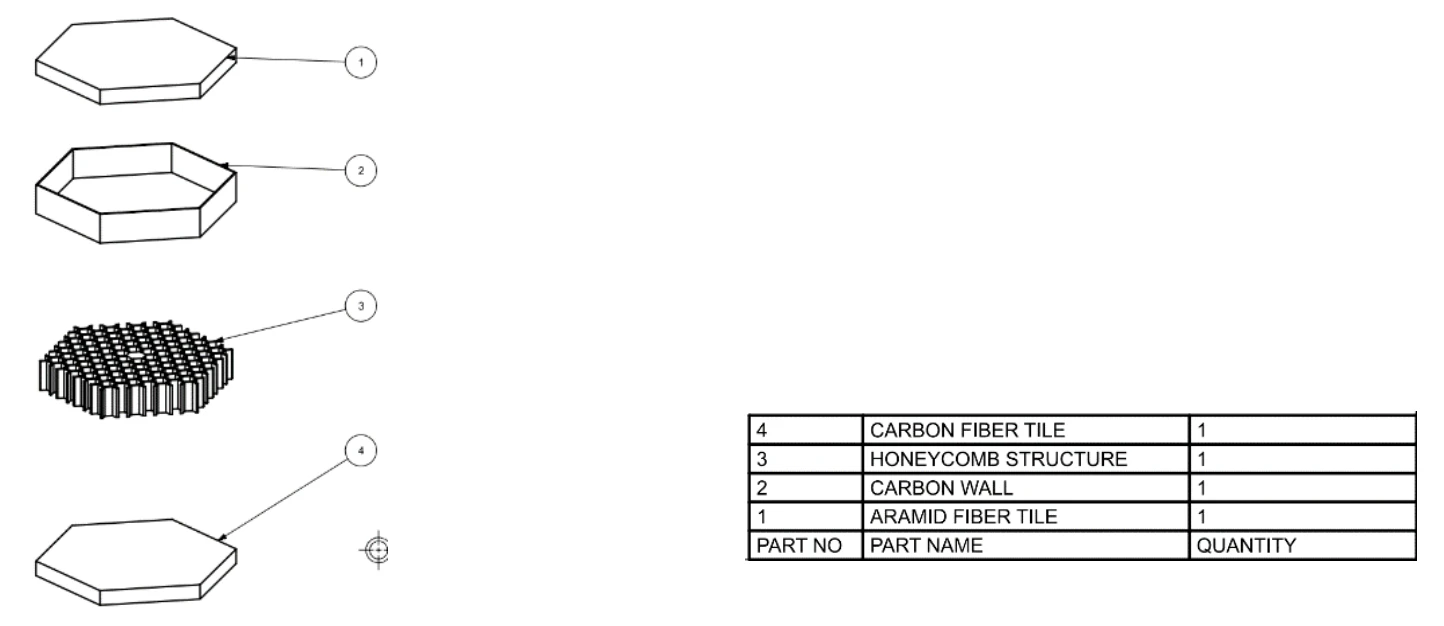
The proposed hexagonal tile is six inches across and two inches thick: a half-inch carbon-fiber outer layer, a one-inch honeycomb core, and a half-inch aramid inner layer. These are concept dimensions, not a qualified thermal-protection stack.
The NX model helped define the layer arrangement before physical testing. Alongside the tile, the system concept includes coolant storage, pumping, and distribution interfaces. Those interfaces introduce their own mass, reliability, and packaging questions.
03 / tradeoffs
Cooling adds capability and complexity.
Active cooling cannot be assessed separately from the rest of the spacecraft. The coolant must remain compatible with the materials and operating environment, while the circuit must tolerate pressure changes and avoid leaks.
The proposal discusses coolant alternatives and environmental concerns rather than treating the initial selection as settled. Likewise, selecting a material for one desirable property does not establish that the entire tile can survive re-entry.
| Design area | Concern | Evidence needed |
|---|---|---|
| Layered tile | Thermal response | Temperature-dependent material data and tests of the assembled stack. |
| Coolant circuit | Compatibility | Fluid selection, pressure limits, leakage assessment, and interface definition. |
| Structural integration | Load transfer | Mechanical tests and analysis of joints and differential expansion. |
| Complete system | Added complexity | A mass, power, and reliability comparison with a passive baseline. |
04 / verification
A proposal needs a route to evidence.
The proposed work moves from architecture and material studies toward prototypes and testing. The document identifies thermal characterization, mechanical testing, and high-heat-flux testing as ways to evaluate the concept; it does not report completed results from those tests.
My main takeaway was how much stronger a design discussion becomes when every claim has a planned check. CAD communicates the arrangement, but requirements, risks, and verification define what would make the arrangement useful.